Let's stay connected!
About me

Hi, I’m Priya Jain—a Kundalini Yoga teacher, mentor, and spiritual guide. With a deep love for ancient wisdom and practical spirituality, I’m here to help you awaken your potential, heal, and transform your life. Let's grow together!
Subscribe & Follow
Discover more about our beautiful community, where spirituality meets everyday life. Let's stay connected and grow together.
Must Read Articles

Persona: The Mask That Forgot It Was a Mask
Jul 31, 2026
The Hungry Ghost
Jul 31, 2026


Did You Choose To Be Born?
May 17, 2026
Topics That Inspire
The Hungry Ghost
Jul 31, 2026
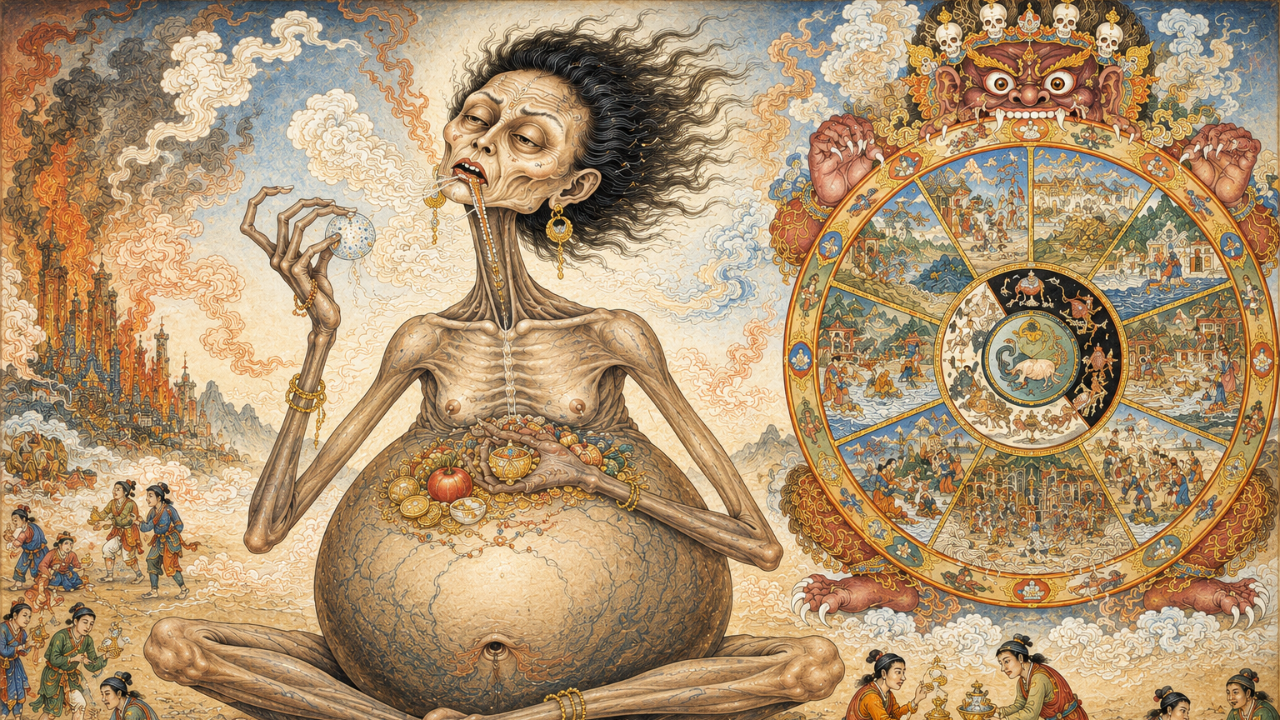
Imagine a being so consumed by hunger that it has forgotten what hunger even feels like anymore.
It wanders through a world full of food — reaching, grasping, consuming — and yet nothing ever reaches the place that aches. Its stomach is enormous, cavernous, the kind that could swallow whole seasons of a life. But its throat is no wider than a needle, and its mouth too small to take in anything of real nourishment. So it eats and eats and remains, after every consumption, as hollow as the moment it began. Not satisfied. Not even close. Just — emptier, somehow, for all the trying.
This is the hungry ghost. One of the six realms of existence in Tibetan Buddhist teaching, depicted in the Wheel of Life as a being condemned to a particular kind of hell — not the hell of fire or punishment, but the hell of perpetual, insatiable wanting. A wanting so total, so relentless, so completely divorced from any possibility of satisfaction that the ghost has lost the ability to even imagine what it would feel like to have enough.
What makes this image so extraordinary — and so uncomfortable — is not how foreign it feels. It's how familiar.
The Realm We Actually Live In
Buddhism didn't place the hungry ghost realm somewhere in the afterlife as a cautionary tale for the wicked. It placed it as one of six states of mind that any human being can inhabit in any given moment. The hungry ghost isn't a mythological creature you meet after death. It's a description of a psychological reality you can slide into between breakfast and lunch on a perfectly ordinary Thursday.
The Buddha taught that the hungry ghost realm is characterised by three specific qualities. Intense craving. The inability to be satisfied. And a fundamental confusion about where satisfaction actually comes from. The ghost keeps looking for relief in the same places it has never found it, with the same strategies that have never worked, with a faith in the next consumption that somehow survives every disappointment.
Does any of that sound familiar?
Because what I've noticed — in years of sitting with people in their most honest moments — is that most of us are not strangers to this realm. We just don't recognise it by that name. We call it ambition, or self-improvement, or just the way life is. We call it drive. We call it needing to decompress. We call it treating ourselves. We have built an entire civilisation of language designed to make the reaching sound reasonable, even virtuous, and to keep us from asking the one question that would stop the ghost in its tracks.
What am I actually hungry for?
How the Ghost Moved In
It didn't arrive fully formed. It grew, slowly and almost invisibly, from something much more innocent.
It grew from the first time you discovered that the world doesn't organise itself around your needs. That comfort has to be waited for. That the wanting can arrive long before the receiving does, and in that gap — in that specific, particular ache of needing something that isn't yet there — the nervous system drew its first conclusion about the nature of reality. There might not be enough. I need to reach while I can.
That conclusion embedded itself below language, below memory, below the level at which we could ever examine or question it. And then life kept teaching the same lesson, in increasingly sophisticated ways. The parent whose attention was finite. The love that came with conditions. The achievement that produced approval and the failure that produced withdrawal. Layer upon layer, the ghost was fed the same story: satisfaction is out there, and you need to reach harder and faster and more cleverly to get there before it disappears.
Dr. Anna Lembke, a Stanford psychiatrist who has spent years studying compulsive behaviour, gives us a neurological portrait of what this does to the brain over time. Every reach for relief — the scroll, the sugar, the glass of wine, the validation, the purchase — produces a dopamine spike. The brain immediately compensates by lowering its baseline sensitivity. The next reach needs to be slightly bigger to produce the same relief. The craving intensifies. The satisfaction shrinks. We need more to feel less.
The ghost's stomach expands with every passing year. The throat never widens. The mouth stays too small for anything real to pass through. And the ghost — exhausted, confused, increasingly frantic — keeps reaching. Because reaching is the only thing it has ever known how to do.
The Ghost You Recognise
I want you to feel into where this lives in your own life. Because it doesn't always look like addiction or compulsion or anything dramatic enough to raise an alarm.
Sometimes it looks like the inability to sit in a room without checking your phone, not because you're expecting anything important but because silence has started to feel like something that needs to be filled before it swallows you. Sometimes it looks like the relationship you stay in past the point of honesty because being alone feels like evidence of something you'd rather not confirm. Sometimes it looks like working yourself to exhaustion and calling it purpose, saying yes past capacity and calling it generosity, performing okayness in rooms where you are anything but okay and calling it strength.
Sometimes it looks like the spiritual seeking that is really just another form of reaching — consuming teachings, practices, retreats, teachers — with the same underlying hunger that drives every other consumption: the hope that this next thing will finally, finally be the thing that makes the ache stop.
The ghost wears many costumes. And it is very, very good at making the reaching look justified.
Yogic philosophy calls the force behind all of it avidya — misperception. A case of mistaken identity so ancient and so complete that it has come to feel like just the truth of who we are. We have forgotten what lives underneath the wanting. And so we keep looking outward — in increasingly creative and desperate ways — for something that was never going to be found out there.
Because what the ghost is actually hungry for isn't a thing. It isn't an experience or an achievement or a relationship or a state of mind that can be reached through any amount of reaching. What the ghost is hungry for is the remembering of what it already is underneath all the hunger.
The yogic tradition calls this the Anandamaya Kosha — the bliss body, the innermost layer of the self that has never been depleted, never been insufficient, never needed a single thing added to it to be complete. Tara Brach calls our forgetting of it the trance of unworthiness — the deep, largely unconscious belief that we are not quite right as we are, that something needs to be fixed or proven or achieved before we are allowed to fully inhabit our own lives.
The ghost has been circling home the entire time. It just keeps mistaking the circumference for the destination.
One Pause
Willpower won't help here. The ghost has been applying tremendous effort to its reaching for years and the effort has only deepened the exhaustion.
What it needs is something far simpler and far more radical than discipline. It needs one genuine pause before the automatic reach. Long enough to feel what's actually underneath the impulse. Long enough to ask — with real curiosity, without judgment — what am I actually hungry for right now?
Not what will fix it. What is the actual hunger beneath this one.
That question, held honestly, is already a different relationship with the ghost. And a different relationship, practiced over time, is how the ghost slowly, imperfectly, finds its way home.
The 14 Day Healing the Scarcity Wound Challenge is a daily practice in exactly this — learning to pause, to feel, and to choose differently. Join us.

The Inner Work Shop...
Is Where Your Practice Goes Next
Your inner life is always evolving. The practice that met you a year ago may not be the one that meets you now, and that is a sign of movement rather than a problem to solve.
The Inner Work Shop is where you will find the courses, challenges, and practices that support the next layer, whether that layer is healing, clarity, courage, or self-mastery.
Trust what calls to you, and let your practice grow as you do.

Our Glow Membership...
Is A Great Place to Ignite your Inner Power
Learn more about the Seventh Chakra Institute of Spiritual Sciences through our Glow Membership, a supportive space for seekers like you to explore your spirituality with grace.
Whether you're just starting or deepening your spiritual practice, you'll find inspiration and empowerment as you discover how Kundalini Yoga and meditation can positively transform your life.
Subscribe To Our Newsletter

Explore
Resources
Connect
Discover more about our beautiful community, where spirituality meets everyday life. Let's stay connected and grow together.
@2025 Seventh Chakra Institute of Spiritual Sciences. All Rights Reserved.